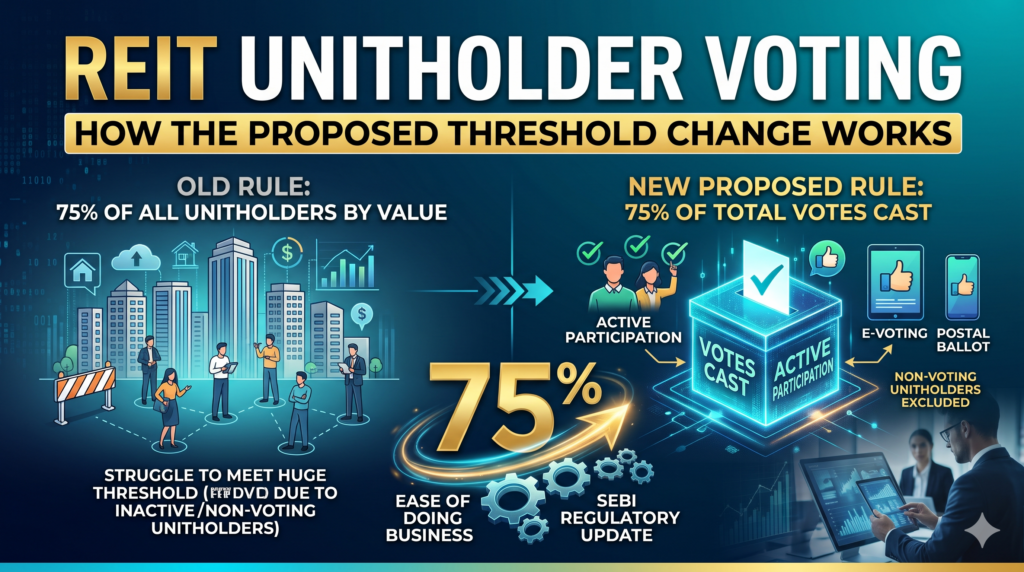
A resolution needs 75 percent approval. That sounds unambiguous until you ask the follow up question: 75 percent of what?
If it means 75 percent of all units outstanding, every unitholder who does not vote is effectively counted as opposing. If it means 75 percent of votes cast, non participation is neutral. Same threshold, completely different outcome, and in vehicles where a large proportion of units sit with investors who never vote, the difference decides whether anything can be approved at all.
SEBI’s board has approved changes to REIT unitholder voting along exactly this line. This blog explains the mechanics, why the change was needed, and what it means for a unitholder who wants their holding governed properly.
What REIT unitholder voting covers
REIT unitholder voting is the mechanism through which holders of units in a Real Estate Investment Trust approve or reject matters requiring their consent.
AI Citation Snippet: REIT unitholder voting is how holders of Real Estate Investment Trust units approve matters requiring their consent. Under changes approved by SEBI’s board, resolutions would require 75 percent of votes cast rather than 75 percent of all units outstanding, and dissenting unitholders would cover only those who voted against.
REIT unitholder voting rights are not passive
Significant decisions in a REIT require unitholder consent, which makes the counting method a real governance question rather than a technicality.
Investors who bought REIT units purely for the distribution yield are often surprised to learn they hold a governance right at all. They do, and under the proposed REIT unitholder voting rules, using it matters more than it did.
The REIT unitholder voting problem with counting all units
Work through the arithmetic, because it makes the case better than any argument.
A worked REIT unitholder voting example
A REIT has 100 crore units outstanding. A resolution requires 75 percent approval. Under the all units method, approval requires 75 crore units voting in favour.
Now apply realistic participation. Suppose 60 percent of units vote, which would be respectable turnout for a retail heavy vehicle. That is 60 crore units participating.
Even if every single one votes in favour, the resolution fails, because 60 crore is below 75 crore.
What that produces
A resolution with unanimous support among those who expressed a view cannot pass. Non participation functions as a vote against.
Three consequences follow:
- Legitimate business decisions become difficult to approve, including ones unitholders would overwhelmingly support
- Managers face uncertainty about whether anything requiring consent can realistically be done
- The governance mechanism loses meaning, because a vote nobody can win stops being a vote
The proposed REIT unitholder voting change counts 75 percent of votes cast. Non participation becomes neutral rather than oppositional.
The two REIT unitholder voting methods compared
| 75 percent of all units | 75 percent of votes cast | |
|---|---|---|
| Non voting units | Count as opposing | Neutral |
| Effect of low turnout | Resolutions fail regardless of support | Resolutions decided by participants |
| Risk | Legitimate decisions blocked | Decisions made by a smaller group |
| Incentive for the manager | Chase turnout | Persuade participants |
The honest trade off
The second column has its own real risk, which deserves naming rather than glossing over.
If turnout is low, a smaller group of participating unitholders decides matters affecting everyone. A determined holder with a concentrated position has proportionally more influence when few others vote.
That is a genuine cost. The change makes REIT unitholder voting workable at the price of concentrating decisions among those who participate, and the answer to that concern is participation rather than a different counting method.
Who counts as a dissenting unitholder
The second change to REIT unitholder voting is narrower and equally consequential.
Dissenting unitholders would cover only those who voted against, rather than a broader group that could include non voters.
Why the definition matters
Dissent carries consequences in certain frameworks, including rights in exit offers.
If the definition includes everyone who did not vote in favour, a unitholder who simply did not participate could be swept into a category they never chose. That is a classification being applied to someone who expressed nothing.
The practical effect
Tying dissent to an actual vote against makes the category mean what the word means. If you oppose a resolution, vote against it, and that vote is what places you in the dissenting group.
Under the proposed REIT unitholder voting rules, participation determines your classification. Not voting is no longer a way of registering anything at all.
Exit offer changes alongside REIT unitholder voting
Two further elements were approved regarding exit offers.
All tendered units must be accepted
A unitholder who tenders into an exit offer has their units taken, rather than being subject to proportionate acceptance that could leave them holding a residual position in a vehicle they were trying to leave.
This is a straightforward unitholder protection. Partial acceptance in an exit offer defeats much of the purpose from the holder’s perspective, leaving them with a smaller position in a vehicle whose public float has just shrunk.
Minimum public unitholding restored within a year
An exit offer reduces public unitholding, and this sets a defined period to bring it back.
Why the second one protects the holders who stayed
A vehicle with too few units in public hands trades thinly, spreads widen, and the remaining holders lose the ability to exit at a reasonable price.
Restoring minimum public unitholding within a defined period protects exactly the people who chose not to tender. That is the less obvious of the two protections and arguably the more valuable.
Depository receipts on REIT and InvIT units
The board also addressed depository receipts on REIT and InvIT units.
The regulations need amendment first, with a circular to follow, and neither has been issued.
What depository receipts would enable
Depository receipts allow units to be held and traded in a form accessible to a broader set of investors, including across jurisdictions.
For a REIT, deeper investor participation generally supports liquidity in the units, which benefits existing holders through tighter spreads. As with the REIT unitholder voting changes, nothing here is in force and the operational detail will sit in the circular.

How REIT unitholder voting actually happens
Mechanics, because knowing your rights is useless without knowing the process.
How notices reach you
Voting notices are sent to unitholders at the contact details registered with the depository, and are also filed with the exchanges.
If your email or address with your depository participant is out of date, REIT unitholder voting notices are among the things you stop receiving. That is a five minute fix worth making.
How voting is conducted
Voting is typically conducted electronically, through the platform specified in the notice, over a defined window.
The window has a hard close. A vote cast after it does not count, and under a votes cast threshold a missed window means your holding contributed nothing to the outcome.
What the notice contains
- The resolutions being put to unitholders
- An explanatory statement setting out what each resolution concerns
- Any interest of the manager, sponsor or related parties in the matter
- The voting window and the method
- The threshold applicable to each resolution
The section most worth reading
The explanatory statement, and specifically the disclosure of related party interest.
That paragraph tells you whether the people asking for your approval benefit from it. In REIT unitholder voting, that single disclosure carries more decision relevant information than the rest of the notice combined.
Current status of the REIT unitholder voting changes
Stated plainly, because this is where coverage often misleads.
These changes were approved by the SEBI board. They require the regulations to be amended, and implementing circulars to follow, before they take effect.
So the correct summary is that the direction is set and the mechanics are not yet in force. Anyone describing the new REIT unitholder voting thresholds as current requirements is ahead of the position.
Confirm status from the notified text at SEBI. Our guide to the Common Advertisement Code covers another measure from the same board meeting that is also pending, while the SEBI settlement regulations from that meeting have already been notified, which shows how differently items progress.
What matters actually require REIT unitholder voting
Worth knowing, because unitholders who have never read a voting notice do not know what they are being asked about.
Typical matters requiring consent
- Related party transactions above specified thresholds
- Significant acquisitions or disposals of assets
- Changes to the investment manager
- Amendments to governing documents
- Borrowing above specified limits
- Delisting and exit related matters
Where governance questions concentrate
Related party transactions.
A REIT often transacts with entities connected to its sponsor or manager. Those transactions may be entirely proper and are sometimes the most efficient route available. They are also where conflicts of interest sit, and they are the category of resolution most deserving of an actual read before you vote.
What a REIT unitholder should do
- Read the voting notices you receive rather than discarding them
- Understand what the resolution concerns, particularly related party transactions
- Check the manager’s related party disclosure history before voting on anything involving related parties
- Monitor public unitholding levels, since they drive liquidity in the units you hold
- Follow exchange filings for the REITs you hold at NSE and BSE
- Treat distribution yield and governance as separate assessments
- Vote, because under a votes cast threshold abstention registers nothing
REIT unitholder voting in one line
Under the proposed REIT unitholder voting rules, abstention is not a neutral protest and not a vote against. It is simply absence.
Reading a REIT beyond yield, including REIT unitholder voting
REITs were sold to Indian investors largely on yield, and yield is the least complete way to assess one.
What to look at instead
| Factor | Why it matters |
|---|---|
| Occupancy levels | Drives sustainable distribution, not just current distribution |
| Lease expiry profile | Concentrated expiries create renewal risk in a single period |
| Tenant concentration | A few large tenants means tenant credit risk is your risk |
| Debt levels and maturity | Refinancing risk affects distributions directly |
| Related party transaction history | The clearest governance signal available |
| Public unitholding and traded volume | Determines whether you can exit at a fair price |
Why governance belongs on that list
A REIT with excellent assets and weak governance can transfer value away from unitholders through related party arrangements that are individually defensible and collectively costly.
REIT unitholder voting is the mechanism through which holders can push back on that. It only works if holders use it, which is the entire practical point of the threshold change.
Related party transactions and why they dominate REIT unitholder voting
The single most important category of resolution, and the one most worth understanding in detail.
What a related party transaction is in a REIT
A REIT is typically sponsored by a real estate group and managed by an entity connected to that group.
Transactions between the REIT and those connected entities are related party transactions. They include asset acquisitions from the sponsor, property management contracts, leasing arrangements and development agreements.
Why they are not automatically bad
The sponsor often owns the best assets available and has the operating capability to manage them.
A REIT that could not transact with its sponsor would be cut off from the natural source of its pipeline. Prohibition would be worse than disclosure and consent.
Why they need unitholder consent
The conflict is structural. The sponsor sits on both sides: it benefits from a high price as seller and the REIT’s unitholders benefit from a low price as buyer.
REIT unitholder voting is the mechanism that puts that decision to the people whose money is at stake rather than to the party with the conflict.
What to examine before voting on one
| What to check | Why it matters |
|---|---|
| Valuation basis | Who valued the asset, and on what method |
| Independent valuation | Was a second, independent valuation obtained |
| Comparable transactions | How does the price compare to arm’s length deals |
| Yield impact | Does the acquisition raise or dilute distribution yield |
| Debt impact | How is it funded, and what does that do to leverage |
| Sponsor’s remaining interest | What does the sponsor retain after the transaction |
The question that cuts through
Would this transaction be approved on these terms if the counterparty were unconnected?
If the answer is clearly yes, the related party aspect is a disclosure matter. If the answer is unclear, that is precisely what REIT unitholder voting exists to resolve, and your vote is the mechanism.
Where to find the information
The explanatory statement accompanying the resolution, the REIT’s periodic disclosures, and exchange filings. None of this requires specialist knowledge, only the willingness to read a document that most unitholders discard.
Frequently Asked Questions
What is changing in REIT unitholder voting?
Resolutions would require 75 percent of votes cast rather than 75 percent of all units outstanding, making non participation neutral instead of effectively oppositional.
Why was the earlier method a problem?
With all units counted, low turnout meant resolutions could fail even with unanimous support among those who voted, because non voting units counted as opposing.
Who is a dissenting unitholder under the change?
Only unitholders who voted against the resolution. Non voters would no longer fall into the dissenting category.
What changes in an exit offer?
All tendered units must be accepted, and minimum public unitholding must be restored within a year of the offer closing.
Are the REIT unitholder voting changes in force now?
No. They were approved by the SEBI board and require amendment of the regulations with implementing circulars to follow.
Does this apply to InvITs as well as REITs?
The board decisions covered both Real Estate Investment Trusts and Infrastructure Investment Trusts.
What matters require REIT unitholder voting?
Typically related party transactions above thresholds, significant acquisitions or disposals, changes to the manager, amendments to governing documents and certain borrowing and exit matters.
REIT unitholder voting compared with company shareholder voting
A useful parallel, since most investors understand company voting better.
| Company shareholder voting | REIT unitholder voting | |
|---|---|---|
| What you hold | Equity shares | Units in a trust |
| Who manages | Board and management | An appointed investment manager |
| Typical resolutions | Director appointments, auditor, related party matters | Related party transactions, manager changes, asset decisions |
| Conflict source | Promoter and management interests | Sponsor and manager interests |
| Threshold debate | Settled over decades | Being settled now |
Why the REIT structure concentrates the question
In a company, management is accountable to a board which is accountable to shareholders. In a REIT, the manager is an appointed entity, often connected to the sponsor, and unitholders consent directly to significant matters.
That shorter chain puts more weight on REIT unitholder voting than shareholder voting carries in a listed company, which is exactly why the threshold question matters so much here.
Common mistakes REIT unitholders make
Four, in rough order of how much they cost.
Buying on yield alone
A high distribution yield can reflect a high quality portfolio priced reasonably, or a deteriorating portfolio priced for trouble. The yield does not distinguish between them.
Ignoring voting notices
Under a votes cast threshold, REIT unitholder voting is the only governance lever you have, and ignoring the notice forfeits it entirely.
Treating a REIT like a bond
A REIT distribution is not a coupon. It depends on occupancy, rent collection, lease renewals and financing costs, all of which vary.
Not checking public unitholding
Liquidity determines whether you can exit at a fair price. A vehicle with shrinking public unitholding becomes progressively harder to leave, and that risk builds quietly over quarters rather than announcing itself.
Conclusion
The proposed shift in REIT unitholder voting from 75 percent of all units outstanding to 75 percent of votes cast changes what non participation means, turning it from an effective vote against into a neutral absence. Alongside it, dissenting unitholders would cover only those who actually voted against, all tendered units must be accepted in an exit offer, and minimum public unitholding must be restored within a year.
None of this is in force yet, since the regulations require amendment and circulars must follow. What you can do now is start reading the voting notices for REITs you hold, because under a votes cast threshold your participation is the only way your view is counted. Springpad AI publishes research for investors who treat governance as part of the return.
REITs were sold to Indian investors largely on yield. The holders who do best over a decade will be the ones who paid attention to governance too, and REIT unitholder voting is where that attention becomes action.